Friday, February 25, 2011

"It's Not Beautiful" by Evan Osnos

Ai Weiwei, Forever Bicycles, 2003

A profile on the Chinese artist Ai Weiwei, "It's Not Beautiful" looks at Ai's role as both an artist and activist.  Ai has dabbled in many types of creative work, including installations, architecture, photographs, furniture, paintings, films, and books.  He has no scruples about standing up to Chinese authorities, whether it be in the form of a protest march to bring attention to the proposed demolition of artists' studios or a "Citizen's Investigation" of the 2008 earthquake in Sichuan.  Through this investigation, he hopes to bring attention to the many children that died in the earthquake and to look into why so many perished in unstable schools.  Using Twitter and a blog (that was only recently shut down), Ai constantly communicates about his work in activism as well as art, attempting to be a source of inspiration and hope for his fellow dissatisfied countrymen.  Though many admire what Ai attempts to do, some consider him out of touch with how far China has come and believe that some of his actions undermine attempts at discussion and conversation with the government.  Ai remains confident in his position, however, and continues with his art and his activism, not caring if people consider it beautiful or not.   

"The Painted Word" by Tom Wolfe

I just want to say that I was entertained by the amusing, sarcastic tone that the author used in this article while he was basically slamming all of modern art.  It's not that I completely agree with all he said, I just thought the way he went about it was silly.  

Anyway, as for my objective summary...Wolfe begins his article with the "discovery" that all of Modern art is essentially literary: "the paintings and other works exist only to illustrate the text" (1).  He then continues by asking how this could be possible, because Modern art was essentially a reaction to "literary" realistic art--where painters would often illustrate well known stories/fables/etc. and try to create an illusion of reality.  The theory of Modern art began with the concept of art for art's sake.  

The artist's realm had moved away from nobility and the upper classes and was now more of a self-imposed separation from the hypocritical bourgeoisie.  The artist was now a bohemian in nature and so could not feel comfortable associating with the upper classes but still needed their support in order to be considered "successful."  Wolfe observes this behavior as taking place in two parts: the Boho Dance, in which the artist acts as if he doesn't care what the cultured people think of his art but still shows his art around, and the Consummation, where cultured people come to this artist's bohemia to try and find new and exciting art.  Wolfe also observes that the public were not part of this transaction.  What they thought did not matter, they were only informed of the decisions made by their superiors after the decisions were completed.

Wolfe then continues through each major Modern art movement, starting with Cubism, moving in Abstract Expressionism, Pop Art, and Minimalism (among others) and shows how with each movement, the avant-garde in art dug itself ever further into a hole composed entirely of Theory.  Each movement had to be more true to the theory or come up with a purer version of the theory than had the last.  It all came to depend so much upon the theories that "ugly" art was often considered the best, as it could be given meaning in the context of a theory.  Wolfe ends with the supposition that future people will look back at this period in art history with amusement.    

Some of the artists referenced in the article:

Willem de Kooning, Woman III, 1953
Jackson Pollock, Number 1, 1950
Roy Lichtenstein, Drowning Girl, 1963

Thursday, February 24, 2011

"A Kind Word for Critics" by Francois Truffaut

Truffaut discusses critics, especially in cinema, and makes some comparisons to the relationship between critics and artists.  He has a positive view of critics, and feels there is a nice rapport between movie critics, filmmakers, and the public.  He makes the keen observation that people are often drawn to movies/art/etc. from other places because there is an element of the exotic to them, as well as the fact that people can judge the work for itself rather than being influenced, for example, by knowledge of the creator that has been splashed all over the media in the place where the work originated.  The less involved we are with a particular artist, the less our biases of them cloud our judgment.  

He goes on to look at how antagonistic many artists are to critics, taking what they say very personally, rather than responding to critiques with "openness" and an interest in joining in the discussion of their work.  But also acknowledges how difficult it is to always maintain such a mindset, as artists pour themselves into their work.  He ends with the observation that although film criticism is important, it is only one aspect of the film's success/reception.  At the end of the day, if something strikes a cord with viewers, that's what really matters. 

And, I just wanted to add that I really enjoyed the ad for the Thesaurus in this article, it was quite fun!-- "Put punch into your prose and sparkle into your speech the easy way--with the new Doubleday Roget's Thesaurus..." 

"Criticizing Art" Chapter 3: pg. 63-86

This chapter discusses how critics describe art and how their descriptions, interpretations, and evaluations of each piece influence each other.  There are three aspects to describing works of art: subject matter, medium, and form.  "Subject matter" means the physical things, people, and places depicted in a work of art.  This is distinct from "subject," which is the theme or main idea of the piece.  "Medium" (plural: media) is meant to refer to a certain way of creating art (painting, sculpture, etc) or the actual materials that are used to create that art.  "Form" is in reference to how the artist presents their subject, specifically, composition and arrangement of a particular medium.  A list of possible "formal elements" is given: "dot, line, shape, light and value, color, texture, mass, space, and volume" (66).  

The rest of the chapter is devoted to looking at six different artists and different critic descriptions/interpretations of these artists' works.  Each of these sections show how in describing artwork, critics often include a mixture of biographical/historical context, pure emotional description of the pieces, an interpretation of the artists' subject, and a tone of approval/disapproval.  An emphasis is placed upon the fact that most critics' descriptions are done in a positive, lively manner.     

Deborah Butterfield, Palomino
Above is pictured a work of art by one of the artists mentioned in the chapter.      

Monday, February 21, 2011

Favorite Pieces of Art [expanded ]

model using only side of charcoal

copy of Degas with crosshatching

diptych with model

"self portrait as someone else"

self portrait

I took pictures of a few of my favorite paintings so here they are, in addition to the drawings that I put in an earlier post. 

Sunday, February 20, 2011

"The Theory and Organization of the Bauhaus" by Walter Gropius

In this reading, Walter Gropius details the main tenets of the Bauhaus.  He speaks initially of a shifting worldview: one where a perceived unity among all things is slowly replacing a more dualistic oppositional worldview.  The Bauhaus seeks to reflect this new unity in all things.  First, the "academy" is addressed, which Gropius believes is a blight on the artist and his growth.  The academy separates artists from the real world and gives them no concrete training.  The Bauhaus seeks to bring the artist back into contact with the concrete world of industry and design, allowing him to work closely with peers and instructors in a technical/craft-based environment during their education.  The ultimate goal of the Bauhaus is stated as being total creative unity in collective works of art.  In order to get to this point, the "Preliminary Course" involves helping the students understand the basic properties of different materials and the fundamentals of design.  The strengths of each individual will be determined.  Then comes more of an "apprenticeship" where the students are given more freedom to pursue creative ideas with the cooperative assistance of others.  All this in preparation for the collective "building" of great works.  


Saturday, February 19, 2011

"The Enveloping Air" by John Berger

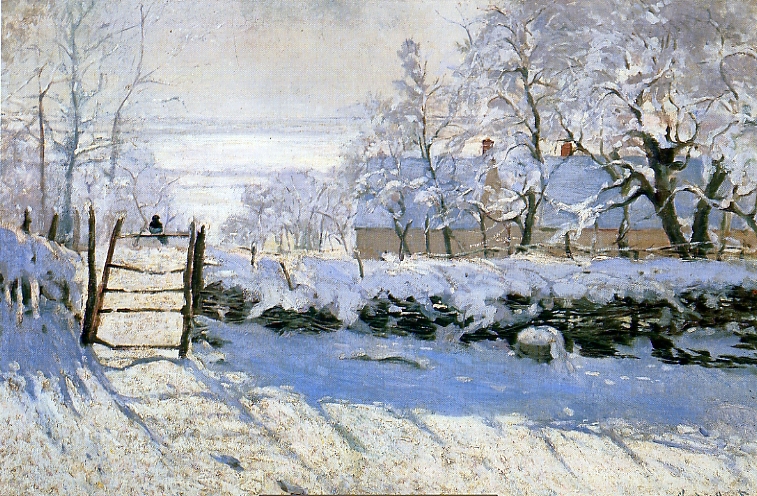
John Berger encourages the viewers of a Monet exhibit to "rethink" Monet: specifically what he was able to do through his art and the effect that it has had on us.  Monet and the other impressionists sought to record fleeting moments in time, focusing on color and light to create the unique feeling of a landscape at a certain time of day, during a specific time of year.  While this is the typical observation of most Impressionist works, Berger references Monet's painting of Madame Monet on her deathbed as one that is indicative of a different Monet.  This painting, he says, is "about the act of leaving, about going elsewhere" (47).  He goes on to say that Impressionist works are about flow, but he doesn't believe that Monet's are really about the flow of time, as other Impressionist paintings are assumed to be.  Monet's are about the flow of air, the "enveloping air," that as he approaches it, takes him elsewhere.  This elsewhere is somewhere anyone can recognize as "universal and eternal" (49).  

Monet, La Pie, 1869