Monday, March 21, 2011

Shoot an Iraqi: pg. 45-127

Wafaa Bilal during his art installation, Domestic Tension
This section of the book begins with Wafaa's server for his project's website being overloaded by the amount of traffic, but the problem is soon solved thanks to his new programmer friend Jason.  A couple days later, Wafaa got an unexpected visit from a Marine who brought him a new lamp (because people had shot his old one) and wanted to tell Wafaa that his project really meant a lot to him.  Wafaa was moved by such a simple, honest gesture.   He also discussed how people visiting the website soon discovered that they could turn the paintball gun into a machine gun, shooting paintballs in quick succession.  As the days passed, the project continued to become more and more widely known, with some people posting really explicit and awful things.  Wafaa was able to have some intelligent conversations with people about his work but a lot of them either didn't care or just wanted someone to talk to.  He continued to develop more post-traumatic stress symptoms and often found it difficult to sleep, in addition to being paranoid and exhausted. 

In the sections discussing Wafaa's past, he talked about the major exams he had to take in order to get into college.  He was excited to get away from home and study art, but unfortunately he was not admitted into the art program because of a cousin who had run afoul of the government.  In college, Saddam tried to keep students from organizing and spreading dissent.  He would send them to military camps during the summer and banned dormitory housing for students the year that Wafaa began school.  Classes and professors were heavily pressured by the Ba'ath Party to teach their philosophy.  Wafaa later left school, convinced that he was being closely watched by Ba'ath Party members and student spies because of his refusal to keep his head down.  He eventually traveled to a refugee camp just over the border in Kuwait and lived there for a time before being transported with the other refugees to Saudi Arabia by American soldiers.        

Shoot an Iraqi: pg. 1-44

 
I have actually finished this book already so I think I'm a little ahead of schedule but I got so into it that I had to continue!  Plus I was on a long plane ride over break so that also factored into my decision.  :)  

The first part of the book introduces Wafaa Bilal and his art project, Domestic Tension.  He decided to live in a room of an art gallery for one month, with a paintball gun aimed at him, that people could fire through a website.  His installation was meant to bring attention to the war in Iraq and to make people think about what it means for soldiers and members of the U.S. military to be able drop bombs on other countries while sitting safely here in the U.S., often not really seeing their target.  He also had more personal motivations for the project, in that his brother and father had recently died back home in Iraq and he wanted to channel his sadness about their deaths and his self-consciousness about living comfortably in the U.S. into a thought-provoking, somewhat controversial installation piece.  

The book continues in an alternating sort of way, switching between narratives about his experiences during the month-long installation and narratives telling bits and pieces of his experience growing up in Iraq.  His family life was characterized by almost constant tension exuded by his father, a man depressed and frustrated with his lot in life.  Wafaa's parents separated several times and so life at home was somewhat unpredictable.  Interspersed with this dialogue, he also talks about the beginnings of his project and people that he met to help him construct the gun, program and website.  The first day that Domestic Tension opened, the atmosphere was somewhat awkward as people did not really know how to respond and Wafaa felt somewhat separate from the people in the gallery but still tried to interact with them.  The beginnings of his project were a little unremarkable otherwise.  The gun would not go off that frequently and so living in the gallery room was pretty bearable.           

Wednesday, March 9, 2011

ArtBreak with James Mullen 3/9/11

James Mullen did a nice job on his talk today.  I liked how he talked a little about the impact that UNH and the faculty here had on his artwork (I feel like most of the other art talks I have been to about the current Museum of Art exhibit haven't more than mentioned the subject).  He mentioned Craig Hood and Scott Schnepf, as well as a couple other professors before my time.  I was really impressed with the variety of media that he has explored in his years as an artist--how he began as an undergrad in printmaking and sculpture, later on got into painting, and more recently into photography.  That is something that I want to do.  Even right now, when I'm doing crafts and other things, I'll get really inspired by a certain material or technique and then do that for a while until I get tired of it and pick up something else.  

I quite enjoyed his landscape work.  I could really see his respect for and appreciation of landscapes and the environment.  Although some of compositions of his earlier paintings seemed a bit awkward, I liked how he incorporated both landscape and still life in order to look at man's relationship with nature--both how we view it and interact with it.  In the below painting, Nature, he really played with many different images of the landscape. 

James Mullen, Nature, 1998
His panoramic work was quite lovely, though for some reason I was a little disappointed when he told us that he projected photographs on his canvas, then traced the forms with charcoal, then painted the landscape.  I guess I just have it instilled in me from school that copying from photographs is somehow cheating.  

James Mullen, 17th Hole Spring Island, 2011
I liked the above piece a lot because he plays with the idea of man-made nature/landscape juxtaposed with natural landscape.  The little pond on the left is a man-made water feature for a golf course, the 17th hole of which is in the middle of the painting, while just off the golf course on the right is this great big salt marsh.  

James also talked a lot about his recent interest in photography, and how it really started when he purchased a digital camera and started taking photographs of everyday things whenever he saw something that interested him--this resulting in a lot of photographs of normal, recognizable objects, but from a unique perspective.  A lot of these also played with light and shadow.  I loved all the different oranges in the below photograph and the beautiful textures created by the netting and the shadows.

James Mullen, Chelsea Construction, 2004
 

Monday, March 7, 2011

"The Artist Interrogated: Interviews and Other Inquisitions"

This reading is an excerpt of some interviews and conversations with artists about their work and art in general.  The artists included are Damien Hirst, Andy Warhol, Jasper Johns, Balthus, Jackson Pollock, and Veronese (mostly modern artists, though not all).  Here are some short summaries of a few of the interviews:  Damien Hirst's involves questioning from the trial of Mark Bridger, an artist who defaced Hirst's work of a lamb in formaldehyde by pouring black ink into it.  Apparently Bridger thought that Hirst would appreciate the unconventional quality of the stunt, but Hirst did not seem to be very pleased.  He said that he thought about leaving the work, but then decided that would make it seem ok for people to come in and do whatever they wanted to works of art.  
Damien Hirst, Away from the Flock, 1994

Andy Warhol converses with a girl Damian about artists, taking risks, and "new" art.  Warhol sees Damian as naive and possessing a hopelessly romantic vision of artists as risk-takers who must make something people may consider bad initially in order to be successful.  Jasper Johns comes across as not being very thoughtful and premeditated about the decision-making in his works, at least until the end of the interview.  Balthus observes to David Bowie that subjects to him often have little or no importance, they are just an excuse to make a painting and to reach an inner feeling or truth.  

Field Trip to ICA 3/3/11

I was so glad to be able to go to the Institute of Contemporary Art because I had been wanting to go for a while.  I did like the building quite a bit, although I was somewhat disappointed in that only one of the floors was being used for exhibit space.  It just seemed like quite a large building to have only one floor of exhibits.  I think my two favorite aspects of the building were the huge glass elevator and the wonderful long glass window at the back of the fourth floor, looking out onto the water.  It was too bad that it was so dark out at that point because it was a little hard to see the view.  

Institute of Contemporary Art, Boston, MA

As for the exhibits, I enjoyed some of Mark Bradford's work.  I liked that he used found materials and that his pieces were often brightly colored and map-like.  Some of them had a wonderful fuzzy depth to them created by the repetition and overlapping of the small rectangular pieces of paper/posterboard/fabric/etc that he used.  The other exhibit was amusing at times--I thought often very stereotypically "contemporary art."  My favorite pieces were the enormous receipt blankets.  I also liked the can on the conveyor belt.  

drawing from "The Lost Thing"
Seeing the animated shorts was so fun!  I loved all of them so much...they were so creative and such wonderful stories.  Madagascar had absolutely gorgeous animation--I loved how all different types of media were included in it.  Let's Pollute was clever and really sad at the same time.  It was very effective at using humor to bring home how much we waste as a society.  I had seen The Gruffalo before and enjoyed seeing it again.  I think one of my favorites was The Lost Thing.  I was just really drawn to the quirky animation and the somewhat distopian world that the animators created. 


Overall I had a lovely time and am so glad we went!    

Sunday, March 6, 2011

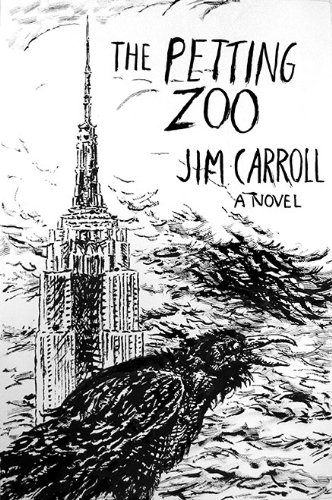
"Off the Rim: Jim Carroll's 'The Petting Zoo'" by Thomas Mallon

Mallon reviews Jim Carroll's The Petting Zoo.  He believes that Carroll's last book, put together posthumously, was an unnecessary, somewhat lackluster addendum to a set of much more interesting earlier works.  Carroll, through The Basketball Diaries, gave a gritty window into his life as a teenager in New York City in the 60s and gathered many followers in the process.  A heroin addict from a young age, Carroll struggled with the drug, while believing that it originally got him into poetry and writing.  Mallon thinks The Petting Zoo lacks much of the honest realism and pizazz--"sex, drugs and rock 'n roll"--that Carroll's earlier works successfully employed.  The main character is somewhat of a bore, though there are some moments of beauty in Carroll's writing.  Mallon almost seems to imply that by the artist's last years, his creativity had been spent, helped in no part by an obsession with drugs all those years.     

"Serra Smiles: The new friendliness of America's most fearsome sculptor" by Peter Schjeldahl, 2000

Richard Serra, Switch, 1999
This article is quite similar to the one summarized in the previous post.  Schjeldahl sees Richard Serra's current sculpture as a dramatic, positive departure from his older works, making installations that have a real playful quality to them.  The author seems to really like "Switch," one of Serra's most recent works, which consists of three pairs of steel walls, all of which curve towards a central point, creating a triangular interior space.  People respond to Switch's beauty, as they move in and around the work.  As Schjeldahl most articulately states, "You cannot use up 'Switch.'"  He believes Serra's work has a lot to teach public spaces where many people congregate and walk through, such as airports, malls and casinos.  Schjeldahl sees Frank Gehry, one of Serra's close friends, as a major influence in his growth as an artist from the depths of "the most menacing paladin of Minimalism."