Although this course did have quite a lot of reading, I really feel like I have learned a lot: about artists I didn't know anything about, specific theories of art, the greater art world/community, etc. This class has also helped me to begin thinking seriously about my own art and myself as an artist. I am so glad that we were required to go to at least 6 art events/talks for Soph. Sem. because I ended up going to the majority of talks that happened this semester and I really enjoyed them! I definitely would not have gotten around to going to many if not for this class and I am really grateful. Hearing artists talk about their own work has been inspiring and thought-provoking.
As for my studio practice, I am hoping to consistently set aside time for myself to do my own artwork, not just classwork. I am hoping that after I come back from Italy later this summer that I will be inspired to do a lot of my own artwork. Right now I have some more sculptural ideas that are knocking around in my head that I would like to pursue before school starts again. I just hope that the summer does not fly by like usual without me getting anything done! Goals for myself for over the summer / fall semester: spend several hours per week working on my own artwork, spend time looking for shows in which to apply/exhibit, and build my resume. I am really excited to continue to define my vision as an artist in preparation for my BFA year...and am definitely a little relieved that I still have another year before I will be stressed out about all that work. But at the same time I can't wait to have the BFA experience because I know it will be a great time of personal growth. Taking Sophomore Seminar, hearing all these different viewpoints and thoughts on art and artists, seeing so much artwork, and thinking about my own work has only further cemented my knowledge that art is what I want to do with my life.

Artful ramblings, etc.
Sunday, May 8, 2011

Sunday, May 1, 2011
"A Room of One's Own, a Mind of One's Own" by Robert Storr
Storr begins his piece by describing all the different places that artists work, from studio space in their homes to rented space in an old factory downtown. Some artists are lucky enough to have expansive, fairytale studios; ones designed around their every whim. Storr reflects on the role of studios in the public imagination: many people see them as mysterious places of divine inspiration and creation. Storr sees the studio as often doing one of two things, either informing clients that the artist is of the same social status as them and is therefore deserving of their respect or creating a theatrically different space, one that separates the artist from the client and adds to the artist's mystique.
De Kooning grew up humbly and upon making a lot of money, he became very nervous and uneasy about it. His studio space, though using up quite a bit of money, was practical, and by design seemingly made to use up the money that made him so uncomfortable. De Kooning actually had his bedroom placed above his studio so at any time of night he could look down at his work from a balcony and ruminate on new ideas. Storr also describes de Kooning's ex-wife's role in helping him get out from under a bad drinking habit by buying him massive amounts of high-quality oil paint (another common artist luxury/indulgence: having unlimited amounts of materials). Arshile Gorky and John Chamberlin were also hoarders of material--Chamberlin's old garage/workspace a myriad palette of old metal and car parts. Storr also goes on to talk about artists who lived and worked in extremely minimal or hermit-esque environments: Raoul Hague with his Gothic house out in the country and Agnes Martin in New Mexico, among others. Storr's parting wisdom is that "artists work where they can, and how they can. There is nothing mysterious about this, since artists must be pragmatic even when they pretend not to be or do the best they can to disguise themselves and conceal their process. The mystery and the marvel is in the work. The rest is contingent reality and real estate."
 |
| Willem de Kooning, A Tree in Naples, 1960 |
Thursday, April 28, 2011
Naked Arts talk with BFA students (part I) 4/37/11
 |
| Shayna Bicknell, Road, 2011 |
Katie seemed a little nervous but I thought she did a lovely job talking about the main concepts behind her work. I loved how she approached the interiors as a series of color comparisons, letting the forms and shapes appear from these interacting relationships. This mindset reminds me a lot of Brian Chu's approach to painting. I liked how she pointed out that her kitchen triptych incorporated both natural and fluorescent light. Besides the wonderful fuzzy quality of her pieces, I most enjoy her unique perspective and the curving of rooms/ceilings that results.
I liked how Shayna compared her different approaches to her smaller paintings as opposed to her larger one that was in the show. It was interesting to me that she felt more comfortable with the smaller works because I often feel like small works can be hard to do, as you have less space to work with and you need to do more with less. I think her command of color is pretty great--my favorite piece was her large work of the stairwell outside the service building.
"Recipe: Perfect Studio Day" by Michael Smith
In this piece, Smith recalls when he was younger and used to look forward to working in his studio because he would easily get swept up in the creative process, captivated by working out new ideas. Now, however, he is merely nervous about working in the studio and not as inspired as he used to be. Now, he spends a lot of time looking through old boxes of work, organizing and trying to find things. At the very beginning of the piece, Smith lists elements of a recipe for a perfect studio day, including fresh coffee and quiet, among other requirements. As he has gotten older, he has decided to add another aspect to his recipe: "embracing distractions." He feels that he is more comfortable when he keeps himself busy and has less time to worry about a blank canvas or an undeveloped idea. He thinks of himself as his own clerk and makes the following interesting statement: "To be busy is to be creative." He holds to the belief that things will eventually work out and find their own place, himself included.
Wednesday, April 27, 2011
"Criticizing Art" Chapter 6: pg. 167-178
The last sections of this chapter talk about how important editing is in the writing process and also that you should use a word processor (an example of how old this book is...I guess this edition is from 2000 though the original was 1994). The section also gives two examples of student writing about art and criticism. The first is a student writing about Robert Mapplethorpe who is of the view that Mapplethorpe's photography furthers moral decay in society by causing people to become desensitized to sexually explicit and masochistic images. The second student piece is a comparison of three critics' views on the photographs of Joel-Peter Witkin. This piece shows how critics can have very different interpretations and judgments of a piece, mostly based on their personal criteria for art. The last couple sections give advice on how to talk about art in different situations (like in a group critique as well as informally with a friend, etc.). The author makes the point that people need to be comfortable with one another and feel like they can talk freely for a good conversation to be able to happen.
Sunday, April 24, 2011
"The Art of the Billionaire: How Eli Broad took over Los Angeles" by Connie Bruck 2010
 |
| Eli Broad |
He since tried to find a place to house his own collection of art and one where he could have almost complete control over the showing and goings on. In a deal with the Los Angeles County Museum of Art (LACMA), he planned on donating his private collection, but in return wanted a building all his own, one that would essentially be separate from LACMA and have its own committee of trustees and director. The Broad Contemporary Art Museum (BCAM) was eventually built but then right before its opening, Broad decided that he would only lend his collection of artwork to the museum to be shown, rather than actually donating it, creating a big ruckus. He then became more involved with MOCA again, as he swooped in to save the museum from a financial crisis in 2008. He is also working on the construction of a building across the street from MOCA to house his collection that would run in tandem with MOCA but be its own entity, one that he can control.
"The Worship of Art: Notes on the new god" by Tom Wolfe 1984
This article is much along the same lines as the last Tom Wolfe article we read. Essentially he is railing on against contemporary/modern art and how ridiculous he thinks it is. His particular point in this article is that art is the new religion of the wealthy and cultured. People do not donate their estates or money to a certain church anymore, they donate it to a major museum or the creation of such a museum. He talks specifically about corporations quite a bit and how they hire art critics/consultants to buy art for them so they can say that they support the arts. And these consultants buy modern, often abstract art, not art that the companies' employees will enjoy. This art is not meant to be enjoyable but is rather a legitimation of this company's wealth and evidence of their support of the arts.
He also goes on for a while about abstract sculptures that are put in front of buildings and in public areas. People wanting to put in a sculpture always employ people from the art world in their decisions resulting in merely a celebration of modern art, Wolfe argues, rather than, say, a monument to Franklin Roosevelt. Wolfe scoffs at critics like Clement Greenberg, who said that "all great contemporary art 'looks ugly at first.'" He also bemoans the fact that now the major reason that the public is going to museums is to learn about contemporary art instead of just going to enjoy the works. He obviously believes there is too much theory going on and it is all a big sham and a waste of people's time.
 |
| Jean Dubuffet, Group of Four Trees |
Thursday, April 21, 2011
ArtBreak with MFA students 4/20/11
I enjoyed these talks because I did not know any of the MFA students at all and I was interested to hear what they had to say about their art and their process. I also came at it from the standpoint that this is going to be me in a little over a year (just a BFA student) and I was hoping it might give me some ideas for what to look at during my BFA year and how I should talk about my own art. I thought the talks were good, although a little on the short side. I mean, I completely sympathize because I am definitely not super comfortable talking about my own work for very long, but I guess I just figured that these are older, more advanced students and I thought they would have more to say. I did like hearing Nicole's talk, I especially enjoyed that she talked about how her's was kind of circuitous journey to get where she is today with her work. It was nice to hear that she had times where she was unsure and searching for an approach to take.
Youngsheen was hard for me to hear, but I liked the concept behind her work. I think it was pretty fascinating that she settled on the interaction of people and mannequins as a microcosm for her experiences being a foreigner in the U.S. as well as in Italy. That sense of otherness and isolation is certainly a universal one that everyone can relate to.
I thought Mark's talk was a little cryptic but I appreciate his use of color and form simplification in his pieces. I could definitely see how he was inspired by dramatic darks and lights like he mentioned at the beginning of his talk. I was curious why he painted the objects that he did--did they have a specific meaning to him or were they just convenient?
 |
| Nicole Weber, Untitled, 2011 |
 |
| Youngsheen Ahn Jhe |
 |
| Mark Soderling, What It Is, 2011 |
"Criticizing Art" Chapter 6: pg. 155-167
The first half of this chapter gives tips and ways of approaching writing and talking about art. One of the major points (at least at the beginning) is that you need to be invested in and passionate about what you are writing. I think this is very important advice. If you aren't invested in your writing, no one else is going to want to read it because they will be able to tell that your heart just wasn't in it (This applies to everything, not just art). The section goes on to look at how you should write about group shows versus solo exhibitions. In group shows you should at least mention most (if not all) of the artists, unless there are more than 10, in which case, focus on the ones you think are most important or the ones you believe give a good overview of the theme/feeling of the exhibition.
The next couple sections are basically overviews on describing, interpreting, and judging, all of which were looked at in detail in previous chapters. The author also goes on to give practical advice, like making sure you know how long your piece of writing is supposed to be before you begin (because this will dramatically change how you write about the pieces). He also advocates looking at the art, taking a lot of notes about it, and letting your thoughts wander for a few days, just so you can best decide what to write about and what angle you should approach your piece from. Additional writing suggestions/cautions are given: avoid plagiarism, make an outline, rewrite, etc.
The next couple sections are basically overviews on describing, interpreting, and judging, all of which were looked at in detail in previous chapters. The author also goes on to give practical advice, like making sure you know how long your piece of writing is supposed to be before you begin (because this will dramatically change how you write about the pieces). He also advocates looking at the art, taking a lot of notes about it, and letting your thoughts wander for a few days, just so you can best decide what to write about and what angle you should approach your piece from. Additional writing suggestions/cautions are given: avoid plagiarism, make an outline, rewrite, etc.
"Museum" 4/19/11

It was fun going to the play on Tuesday in that it was a nice change of pace from our normal class. I thought the actors all did a good job. It definitely seemed like they had a good time playing all the outrageous personalities/characters. I did think that a lot of the characters were just stereotypes but there was certainly a lot of truth to some of them. It's funny to me how art and museums are used for all sorts of things, like socializing and showing others how "cultured" you are. It's also pretty amusing how museums tend to be such stifling, serious environments. I'm sure a lot of artists would appreciate their art being shown in a more relaxed atmosphere. But then if you think about it, this might take away from people's serious contemplation of what the pieces are trying to convey. And I feel like art being on a pedestal in a museum is almost our societal way of giving it legitimacy--like these works are important, therefore we must raise them up on this pedestal in order for you to contemplate them. I don't know...there is a lot of contradiction and sillyness that exists in society's relationship with art and artists.
Sunday, April 17, 2011
BFA/BA/MFA Opening at the Museum of Art 4/15/11

I quite enjoyed this exhibit! It was so much fun to see the final product of everyone's hard work. It was especially meaningful to me this year because I had seen some of the BFA candidates work in progress (Josh and Katie mostly) and it was exciting to see their work framed/finished and in a gallery setting. I could not believe how many people were at the opening! It was crazy! I definitely want to go back at some point when I can spend more time looking at each piece without having to dodge people and try and get out of their way.
I think my favorite works were Josh's, Katie's, and Liz's. I had talked to Josh a little about the ideas behind his work and I think the forms he was able to create were just absolutely beautiful. He told me that for at least one of his pieces, he kind of wanted it to look like a piece of machinery/a tool that had been discarded that people found and decided to use for something else. I think his thought process behind his pieces is really interesting and thought-provoking.
 |
| Joshua Torbick, Bent Ash Bench, 2011 |
 |
| Katharine Austin |
Barbara Kruger "'Taking' Pictures" 1982
 |
| Barbara Kruger, Untitled (I shop therefore I am), 1987 |
"Road Show: The journey of Robert Frank's 'The Americans'" by Anthony Lane 2009
This article is about Robert Frank's project "The Americans" and what his photographs revealed about our country at a time when people were not too keen to hear what he had to say. Frank was born in Sweden, came to the U.S. after WW II, and applied for a Guggenheim grant in the 50s for his proposed project. Upon winning the grant in 1955, he set out on a grand road trip across the U.S., spending some time with his family in California but ultimately using most of his time to travel back and forth across many states, accumulating tens of thousands of photographs.
People were initially antagonistic towards Frank's work, seeing it as critical of America, whereas Frank approached his work through the lens of discovery and a recording of all that he saw. His work was honest, not necessarily critical or complimentary. Revealing a lot about social issues during that time, Frank took many photos portraying the African American experience and his pictures did not shy away from other issues such as class disparity and the working class experience. Frank's work is most important in its blatant honesty and its subtle portrait of a country.
 |
| Robert Frank, Parade--Hoboken, New Jersey, 1955 |
 |
| Robert Frank, Charleston, South Carolina, 1955 |
 |
| Robert Frank, U.S. 285, New Mexico, 1955 |
"No More Boring Art: John Baldessari's crusade" by Calvin Tomkins 2010
John Baldessari is a provocative conceptual artist whose most recent retrospective was shown at the Metropolitan Museum of Art in New York. Baldessari made abstract expressionist paintings early on in his career but soon switched to more conceptual art incorporating photographs and printed words. In his work, the idea is more important than the image and his art is about leaving things out so that the viewer can fill them in. In addition to being an influential conceptual artist, Baldessari was a well-respected teacher. He worked at various schools, including CalArts right after it opened, and influenced many students. Some believe that his role as a teacher was more important than his art. Baldessari was married and had two children, but the marriage didn't last. His wife felt he was too focused on his work and his teaching to really have time to contribute to a marriage/family. Some have criticized Baldessari's work for being to silly/funny and not serious enough. Others seem to only see pretension and little talent in much of conceptual art. Baldessari's response was, "If I were trying to be funny, I wouldn't be doing this" (48). Through his art, he wants to make people stop, stare, and try to understand.
 |
| John Baldessari, "Semi-Close-Up of Girl by Geranium (Soft View), 1966-8 |
"Criticizing Art" Chapter 5: pg. 143-154
This second section of Chapter 5 describes four main categories/theories of art: realism, expressionism, formalism, and instrumentalism. Realism is the belief that nature should be the reason for making art and art should be held to the standard of nature. This theory is one in which artists try to accurately portray the world they see. An example:
Expressionism caters more towards the artist's feelings and expressions than to the object(s) depicted in the work. In this theory of art, the handling of the materials tends to be more apparent than in realism. Though this type of art is not just about the objects/subject, it is not entirely about form either.
Formalism is art about art. It is primarily concerned with form and divorcing artwork from life and culture. An example:
Instrumentalism is art that is done for a higher purpose, to get across a point or message. It recognizes that art is not just aesthetic. Political and activist art are good examples of instrumentalism.
Critics often have a particular theory that they believe in and they tend to write their criticism from this point of view. It can be more helpful, however, to look at pieces of art from the viewpoint of the theory that they have been created in.
 |
| Chuck Close, Nancy, 1968 |
Formalism is art about art. It is primarily concerned with form and divorcing artwork from life and culture. An example:
 |
| Agnes Martin, Untitled, 1960 |
Critics often have a particular theory that they believe in and they tend to write their criticism from this point of view. It can be more helpful, however, to look at pieces of art from the viewpoint of the theory that they have been created in.
Monday, April 11, 2011
"Searching for Silence: John Cage's art of noise" by Alex Ross 2010
 |
| John Cage |
"The Death of the Object: The Move to Conceptualism"
This article was quite long and chock-full of information about several decades in art history, mentioning many many names and movements within conceptualism and the transition into this type of art. Starting in the late 60s, the reading looks at art commenting on politics and radical artist groups, especially in Europe, such as CoBrA. The use of Decollage (tearing advertisements or public posters to create new and interesting images) was involved with Lettrism. Broodthaers was an important artist from this time period. In the late 60s he commented on art museums in some of his works, creating collections of objects that looked like they could be in a museum and pairing them with signs like "This is not a work of art." The Arte Povera movement in Italy was going on concurrently, as a response to the traditional art aesthetic there. There was much friction between the north and the south at this time, in addition to student protesting.
In the U.S., Robert Smithson helped shape the Land or Earth Art movement. One of his most well-known works is Spiral Jetty, where he had workers move earth into the shape of a spiral, extending the jetty into the Great Salt Lake. In the move into conceptual art, the main point of this movement was that thought was a significantly important part of art and a medium in itself. Victor Burgin used photography and text to create commentary on advertisements and the mass media in one of his pieces, "Possession." Bernd and Hilla Becher used photography to create a sort of faux-scientific study of industrial buildings like water towers and organized the photos into alike sections. Feminism in art was emerging during this time and also body/performance art.
 |
| Robert Smithson, Spiral Jetty, 1970 |
"Western Disturbances: Bruce Nauman's singular influence" by Calvin Tomkins 2009
 |
| Bruce Nauman, One Hundred Live and Die, 1984 |
Saturday, April 9, 2011
"Sentences on Conceptual Art" by Sol LeWitt 1969
LeWitt's piece is a collection of 35 statements about conceptual art, some of which detail the artist's role and thought process, others of which read sort of as founding theories or tenets of the avant-garde movement. LeWitt emphasizes that conceptual art is not logical. It is rather the product of a beginning concept that often changes and evolves as things come to the artist during the process of creating the work. Just an idea can be a work of art; it is not necessary to have a physical object as an outcome. In this vein, the spoken or written word can also be employed in the creation of conceptual art. Much of conceptual art is breaking away from tradition and the use of traditional materials (such as in painting and sculpture). I was especially interested in LeWitt's last four statements:
"32 Banal ideas cannot be rescued by beautiful execution.
33 It is difficult to bungle a good idea.
34 When an artist learns his craft too well he makes slick art.
35 These sentences comment on art, but are not art."
"32 Banal ideas cannot be rescued by beautiful execution.
33 It is difficult to bungle a good idea.
34 When an artist learns his craft too well he makes slick art.
35 These sentences comment on art, but are not art."
"Criticizing Art" Chapter 5: pg. 121-142
This section begins the chapter on "Judging Art." It looks at the judgments and interpretations of several critics concerning the work of Frida Kahlo, Martin Puryear, and Romare Bearden. In regards to Kahlo, two critics' reviews of her and her work are looked at in depth: Peter Plagens and Hayden Herrera. Plagens' review is a little sarcastic and not quite as appreciative where Herrera's is very positive and complimentary. This is an example where both critics agree on a lot of facts and interpretations of Kahlo's work, but they disagree about how important her work is.
The next section discusses the sculptures of Martin Puryear. The judgments of Puryear's work are consistently positive, though for varying reasons. Some critics like his work because of how mysterious it is. Others appreciate his work because they believe he stays true to himself as an artist, does work that he wants to do, and doesn't fall prey to popular influences. Yet others like how his forms really elicit strong feelings in viewers--how is work is very emotional. Many praise Puryear for his exquisite craftsmanship that he makes look easy.
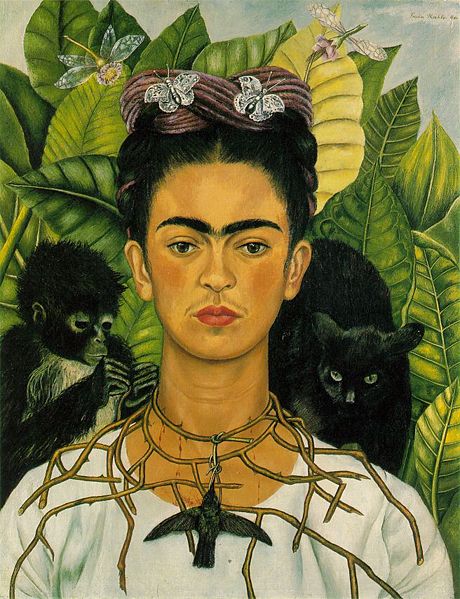 |
| Frida Kahlo, Self Portrait with Thorn Necklace and Hummingbird, 1940 |
 |
| Martin Puryear, Alien Huddle, 1993-5 |
 |
| Martin Puryear, Old Mole, 1985 |
The collages of Romare Bearden are all agreed to be good art, but each critic goes about reviewing him in his/her own way. Some talk extensively about his southern background while others emphasize how they feel he has beautifully captured the essence of the black south. Some compare his collages to his paintings.
 |
| Romare Bearden, Recollection Pond, 1975 |
At the end of this section of the chapter, negative judgments are briefly looked at through the lense of David Salle's paintings. His paintings tend to portray women as objects and as the sexual playthings for men and so many critics fault him for his objectification and continuation of stereotypes. Robert Storr, however, believes Salle's paintings show that no one can control how they are represented and is more positive about his work.

Subscribe to:
Posts (Atom)